
An MRI revealed a Synovial Cyst between my L4 and L5 vertebrae. Unequal leg length created scoliosis that compressed the cyst, sending pain down my leg. I felt disabled; lying down was the only relief. What kind of life was that?
After three weeks at Dr. Morris’ clinic, I started to feel better—and kept improving. My pain now ranges from 0 to 3, and I’m back on my feet at work for nearly 10 out of 12 hours. I’m so grateful I found you.
Eileen Oh, Pediatric Nurse
If your doctor has told you that you have a synovial cyst in your back, and treatments like rest, ice, anti-inflammatory meds, and stretching haven’t helped, you might be facing recommendations for spinal injections or surgery.
You’ve likely done your own research and noticed these options don’t seem ideal. Yet the pain can be so severe that standing, walking, or working feels impossible—relief only comes when you lie down. This isn’t how you want to live.
Understanding Synovial Cysts: What Are They?
A synovial cyst is a fluid-filled sac, similar to a blister, that forms where two vertebrae rub together at a joint called a facet.
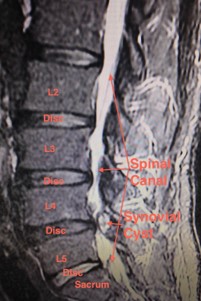
Fig 1.
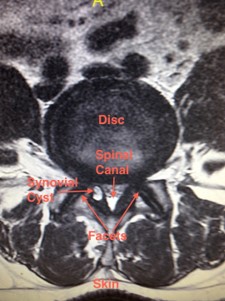
Fig 2.
Fig. 2 shows a cross-section MRI of the lumbar spine with the cyst expanding into the spinal canal. Because this canal holds the spinal cord and nerves, the cyst can cause intense back and leg pain.
What Causes a Synovial Cyst?
Abnormal or excessive movement of the facet joints can lead to cyst formation. Common causes include:
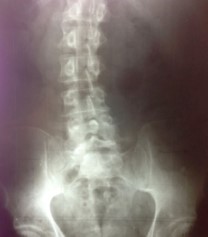
Scoliosis
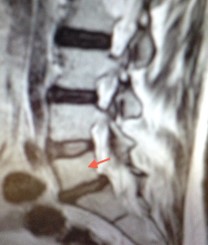
Spondylolisthesis
- Scoliosis: Sideways curvature of the spine causing uneven stress.
- Spondylolisthesis: Forward slipping of one vertebra over another.
- Leg Length Inequality: Uneven legs can tilt the pelvis, often leading to scoliosis.
- Previous Back Surgery: Procedures like discectomies or fusions may cause abnormal motion at adjacent levels.
- Hyperelastic or Unstable Joints: Some individuals have naturally loose ligaments or injuries causing joint instability.
- Facet Tropism: Facets shaped abnormally can move irregularly.
How Is a Synovial Cyst Diagnosed?
Only an MRI can confirm a synovial cyst. The images above show fluid-filled cysts emerging from the facet joints, often narrowing the spinal canal or intervertebral foramen, which compresses nerves—a condition called spinal or lateral stenosis.
Standing usually worsens pain, while flexing forward (like bringing knees to chest) often eases it. Synovial cysts mostly develop after age 45.
Many patients confuse these symptoms with spinal stenosis itself, since the cyst actually causes the narrowing.
Treatment Options for Synovial Cysts
Let’s review your options:
- Epidural Injections: Cortisone injections target inflammation and may even rupture the cyst. However, there are risks such as nerve injury or infection, though rare. Benefits are often temporary since the underlying cause isn’t corrected. Referral from Dr. Rick Morris ensures you see skilled providers.
- Surgery: Removing the cyst surgically is possible but can lead to scar tissue and recurrence if spinal mechanics aren’t addressed. More invasive surgeries like laminectomy or fusion carry higher risks and should be last resorts.
- Physical Medicine: Heel lifts, targeted exercises, posture correction, spinal alignment, and non-surgical decompression can offer long-term relief. Our team at Dr. Rick Morris frequently helps patients avoid surgery through these hands-on treatments. Continuing exercises post-pain relief maintains stability.
Synovial cysts cause spinal narrowing that leads to back and leg pain. Diagnosis requires an MRI, and effective treatment involves addressing the root cause of joint irritation. Surgery should be reserved for when other treatments fail.
We treat this condition daily at Dr. Rick Morris in Los Angeles, CA , S. Pasadena, CA, often preventing the need for injections or surgery.
If you’ve been diagnosed with a synovial cyst, please contact us before considering invasive procedures.