
Nearly 30% of My Patients With Severe Lower Back Pain Have This Condition…by Dr. Rick Morris
My name is Laura. I was diagnosed with grade II Spondylolisthesis. Multiple surgeons recommended spinal fusion surgery, but I wanted to try every possible therapy before going that route. This was my last hope before surgery…
Understanding What Causes Spondylolisthesis
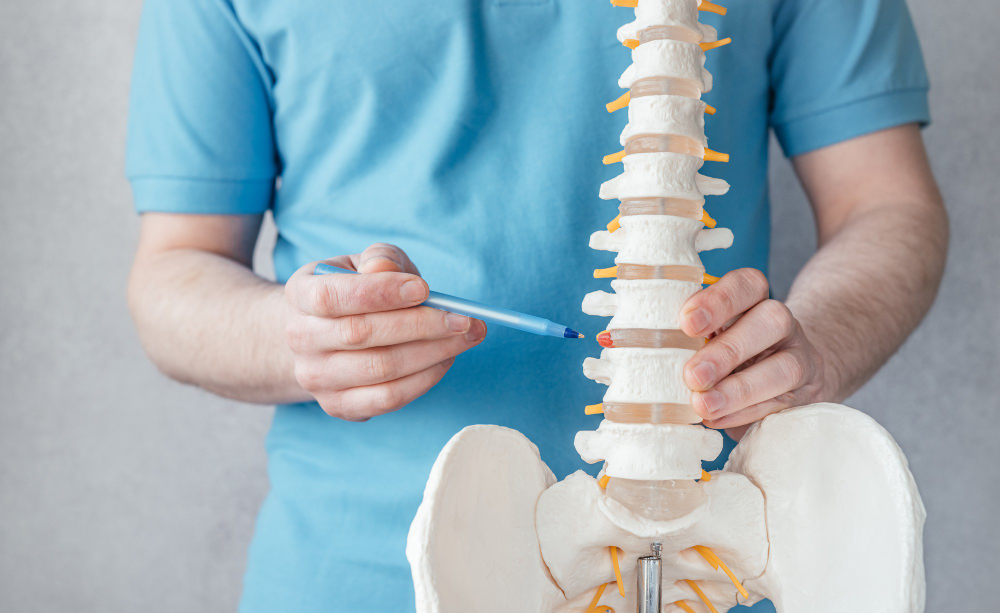
Typically, the whole vertebra doesn’t slip; often just the front half shifts forward, usually breaking at the Pars Interarticularis—a thin, stress-prone area (see figure below). These fractures often happen from falls onto the buttocks during childhood. The pain is usually brief and often unnoticed by parents. Over time, the fracture heals with tough fibrous tissue.Sometimes, this results in chronic back pain, and sometimes it doesn’t.The back half of the vertebra may also slide slightly backward, which can sometimes be felt as a small bump when massaging the back.The Pars Interarticularis is the spine’s weakest point because it connects the front and back halves and is made of cartilage. It takes years after birth to fully ossify. In some cases, due to heavy bending or lifting in youth, the two halves don’t fuse properly, a condition called Spondylolysis. When the front half slips forward, it’s Spondylolisthesis.Genetics play a role: if a relative has a Spondylolisthesis, your risk increases fivefold. This condition is often linked to Spina Bifida Occulta, a genetic spinal abnormality affecting 15% of people. In these cases, parts of the posterior spine such as the lamina and spinous processes are missing, sometimes causing hair growth on the skin above.The missing parts mean ligaments can’t stabilize the spine properly, increasing instability and risk of slippage. Studies show those with Spondylolisthesis have a 65%-465% higher chance of Spina Bifida Occulta than average.It’s not just kids falling on their bottoms who get it. Teenagers during growth spurts, and elderly people with arthritis or disc degeneration, can develop it too. Repetitive heavy lifting, bending, gymnastics, deep squats, and deadlifts are common causes. Excessive intensity or frequency can fracture or wear down the pars, leading to vertebral slippage.Hormones have been suggested as a cause since males are affected twice as often as females. However, since boys more often do contact and high-intensity sports, this theory is not definitive.Although most cases affect the lower back, the neck can also be involved, especially after car accidents or severe arthritis. Neck stabilization requires treatment by a doctor experienced in that area.
So, I Understand the Cause—How Do I Treat It?
First, it’s vital to know if the Spondylolisthesis is unstable. Most are stable, but unstable cases usually require surgery.Determining instability is straightforward but often overlooked. Many patients have been told they need spinal fusion when conservative care would work better.The doctor orders a side-view x-ray (lateral view) while bending forward and backward. If the vertebra with the slip moves more than 4-5 mm between positions, it’s unstable and surgery is likely best. If less than 4-5 mm, conservative care usually succeeds.For lumbar cases, strengthening the lower and oblique abdominal muscles is critical—more so than in typical spines. These muscles help stabilize the spine and prevent slippage.
Additional Tips
- Avoid high heels,
- Maintain a healthy waistline,
- Lighten your purse and carry it as a clutch,
- Limit repetitive bending and twisting,
- Seek spinal care at the first sign of back trouble,
- Chiropractic rotational adjustments should be gentle and targeted,
- Traction devices, like inversion tables or neck traction, can be beneficial but discuss with your doctor before use.
At Dr. Rick Morris, our Spinal Stenosis and severe disc disorder clinic sees nearly 30% of severe low back pain patients with at least one Spondylolisthesis—over seven times the average rate. This underscores the importance of proper care, even if symptoms are mild.The good news? Surgery is rarely needed. Conservative treatment by doctors who truly understand Spondylolisthesis often leads to excellent results.